

Commercial refrigeration Sydney businesses rely on often operates for long hours or continuously, which means small efficiency problems can add up over time. A refrigerator that is poorly maintained, incorrectly sized or positioned beside a major heat source may need to work harder than necessary to maintain the required temperature.
Australian Government energy guidance notes that refrigeration can represent a significant proportion of total energy consumption for some businesses. It recommends regular monitoring, scheduled maintenance, correct temperature settings and careful system design as ways to improve refrigeration efficiency.
For cafés, restaurants, supermarkets, bakeries, caterers and other food businesses, however, saving energy cannot come at the expense of temperature control. Potentially hazardous cold food generally needs to be maintained at 5°C or below under NSW food-safety requirements.
The most useful approach is therefore to make the refrigeration system work efficiently while continuing to provide the temperature, capacity and reliability the business actually needs.
Why Commercial Refrigeration Can Use So Much Electricity
Commercial refrigeration Sydney businesses use differs considerably from a typical household refrigerator. Larger refrigerated cabinets, display units, freezers and cold-storage systems may operate continuously while dealing with frequent door openings, warm stock, lighting and changing ambient temperatures.
Australia’s Energy Rating program explains that commercial refrigerated cabinets can use substantial amounts of energy and can be expensive to operate. It recommends considering the lifetime cost of a unit, including purchase, installation, maintenance and running expenses, rather than assessing equipment on purchase price alone.
The first energy-saving step is therefore understanding which refrigeration equipment is consuming power and why.
A business with several commercial fridges Sydney staff use throughout the day may find that one older cabinet is running almost continuously while newer units maintain temperature more efficiently. Another business may discover that stock is blocking internal airflow or that a refrigerator is unnecessarily oversized for its actual storage requirements.
Regular observation and energy monitoring can make these patterns easier to identify.
Identify Signs That Equipment Is Working Too Hard
Commercial refrigeration Sydney operators should pay attention when refrigeration behaviour changes.
Long compressor run times, difficulty maintaining temperature, excessive frost, unusually warm areas around the equipment or increased energy consumption can all justify further investigation. These signs do not prove that a specific component has failed, but they indicate that the system may need inspection.
Simple operational issues can also increase energy demand. Government guidance recommends avoiding overstocking, keeping air grilles clear, checking thermostat and defrost settings, reducing heat gain and monitoring refrigeration performance.
Before assuming that equipment must be replaced, it is worth checking whether cleaning, maintenance, airflow or operating practices are contributing to the problem.
That leads directly to one of the most practical ways to improve efficiency: looking after the equipment already in place.
Commercial Refrigeration Sydney: Prioritise Maintenance
Keep Condensers, Vents and Components Clean
Commercial refrigeration Sydney equipment needs to release the heat removed from the refrigerated space. If airflow around heat-rejection components is restricted, the system may need to work harder.
Dust, grease and debris can accumulate around refrigeration equipment, particularly in busy kitchens where cooking produces heat and airborne grease.
Australian Government energy guidance recommends regular scheduled cleaning and maintenance to help refrigeration systems maintain energy efficiency and temperature control while reducing system problems or failures.
The exact cleaning and servicing requirements will depend on the refrigerator and manufacturer, so businesses should follow the maintenance instructions supplied with their equipment.
Staff can also help by keeping ventilation areas unobstructed and reporting unusual operating conditions instead of waiting for a complete breakdown.
These basic habits are particularly important for commercial refrigeration equipment installed in kitchens, preparation areas or other demanding environments.
Use Preventative Maintenance Instead of Waiting for Failure
Commercial refrigeration Sydney maintenance is easier to plan when it is scheduled rather than triggered only by a breakdown.
Preventative servicing gives a refrigeration technician an opportunity to assess equipment condition, temperatures and components before a developing issue becomes a larger operational problem.
Government energy guidance specifically recommends servicing refrigeration components according to manufacturer requirements. It also notes that scheduled cleaning and maintenance can improve efficiency and minimise system problems.
Preventative maintenance cannot guarantee that a refrigerator will never fail. Components can still develop unexpected faults.
Its value is that obvious deterioration, unusual operating conditions and servicing requirements can be addressed before the business is forced to respond during a busy service period.
For food businesses, reliability matters alongside energy consumption because temperature problems can also place refrigerated stock at risk.
Commercial Refrigeration Sydney: Control Cold-Air Loss
Check Doors, Seals and Everyday Staff Habits
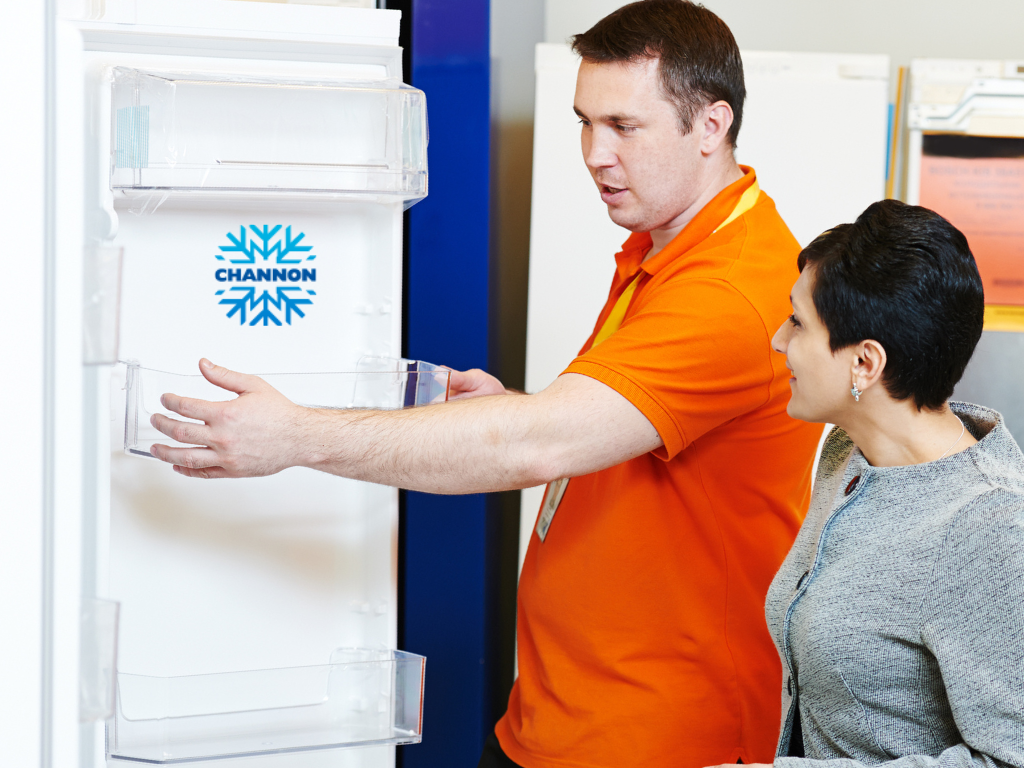
Commercial refrigeration Sydney businesses can lose efficiency through something as simple as a door that does not seal correctly.
Every time warm air enters a refrigerated cabinet, the system needs to remove additional heat. Frequent or unnecessarily long door openings can therefore increase the refrigeration load.
Damaged door seals can create a similar problem because cold air escapes while warmer surrounding air enters the cabinet.
Although consumer and commercial equipment differ, the underlying operational principle remains useful: NSW Food Authority guidance advises keeping refrigerator doors closed where possible and ensuring seals remain in good condition to help maintain refrigeration performance. It also warns that overloading can restrict cold-air circulation.
In a commercial setting, staff should also avoid blocking internal air vents with cartons, trays or food containers.
Small operating habits become important because they occur repeatedly throughout the trading day.
Maintain Food-Safe Temperatures Without Excess Cooling
Commercial refrigeration Sydney operators should not try to save electricity simply by raising storage temperatures beyond safe limits.
NSW Food Authority requires potentially hazardous cold foods to be maintained at 5°C or below unless another permitted method of temperature control is being correctly applied.
At the same time, setting a refrigerator unnecessarily colder than its application requires can increase energy consumption.
Australian Government energy guidance therefore recommends checking thermostat and defrost settings against actual operating conditions.
Businesses should monitor the temperature of the food rather than relying only on how cold the cabinet feels. NSW food businesses handling potentially hazardous food are also required to have access to an accurate probe-type thermometer.
The objective is stable, safe refrigeration, not simply the lowest thermostat setting available.
Commercial Refrigeration Sydney: Choose Efficient Equipment
Compare Lifetime Cost, Not Only the Purchase Price
When replacing commercial refrigeration Sydney equipment, purchase price is only one part of the decision.
A less expensive refrigerator may initially look attractive, but its energy use, servicing requirements and expected operating life can substantially influence the eventual cost to the business.
Australia’s Energy Rating program specifically recommends considering the lifetime cost of commercial refrigerated cabinets. This can include the equipment itself, installation, maintenance and ongoing energy use.
Relevant commercial refrigerated cabinets are also regulated under Australia’s Greenhouse and Energy Minimum Standards framework, with the current refrigerated cabinet determination having commenced on 5 October 2024.
Businesses reviewing commercial refrigeration equipment for sale should therefore compare products of similar type and capacity rather than selecting equipment solely because it has the lowest advertised purchase price.
Warranty terms, service support and parts availability also deserve consideration because commercial refrigeration can be critical to daily operations.
Match Refrigeration Capacity to Real Business Needs
Commercial refrigeration Sydney equipment should be large enough for the operation, but simply buying the biggest cabinet available is not necessarily efficient.
Government energy guidance warns that oversizing refrigeration systems can increase both initial capital cost and ongoing energy costs. It recommends designing refrigeration around present and future business requirements.
The same principle applies when selecting individual commercial fridges Sydney businesses use for food storage or display.
A café with relatively small daily stock requirements may not need the same capacity as a supermarket or high-volume restaurant. Conversely, choosing equipment that is too small can result in overloading, poor airflow and operational difficulties.
Before purchasing, estimate the normal volume of refrigerated stock, peak requirements and the type of products being stored.
The right capacity allows the business to maintain proper airflow and temperature control without paying to cool significant unused space.
Commercial Refrigeration Sydney: Improve Placement

Keep Refrigeration Away From Unnecessary Heat
Where commercial refrigeration Sydney equipment is installed can affect how hard it needs to work.
A refrigerated cabinet located beside ovens, fryers, cooking ranges or other heat-producing equipment may experience a higher refrigeration load than the same unit placed in a cooler area.
Direct sunlight can create another unnecessary source of heat.
Australian Government guidance recommends reducing heat gain from other equipment and sunlight and positioning refrigeration away from heat sources where practical.
Kitchen layouts do not always provide complete freedom over equipment placement, particularly in established premises. Even so, placement should be considered when renovating, replacing equipment or designing a new hospitality fit-out.
A slightly different location can sometimes improve airflow while also making the refrigerator easier for staff to access.
Give Condensers and Ventilation Space to Work
Commercial refrigeration Sydney installations also need suitable ventilation.
Refrigeration removes heat from the cabinet or cold space and releases that heat elsewhere. If a condenser cannot reject heat effectively because airflow is poor, performance may suffer.
Government guidance recommends locating condensers and heat exchangers where there is good airflow and heat can be discharged effectively.
Businesses should follow manufacturer clearance requirements rather than pushing equipment tightly against walls or surrounding it with stored items.
The installation environment should also be considered when comparing commercial refrigeration equipment for sale. A unit that fits the available floor dimensions may still be unsuitable if there is not enough clearance for ventilation, servicing or door operation.
A knowledgeable refrigeration supplier can help assess these practical requirements before equipment is ordered.
Commercial Refrigeration Sydney: Leasing and Rental Options
Consider Leasing When Upgrading Older Equipment
Replacing inefficient commercial refrigeration Sydney equipment can involve a significant upfront cost.
For some businesses, a commercial fridge lease may provide another way to access newer equipment while spreading payments over an agreed period.
Leasing does not automatically make an upgrade cheaper. The business still needs to compare the total cost, contract length, ownership arrangements, servicing responsibilities and any end-of-term payment.
From an energy perspective, the important question is whether the replacement equipment is appropriately sized and more suitable for the business than the system it replaces.
Government energy guidance suggests that older refrigeration systems can present significant opportunities for efficiency improvements and recommends considering replacement for systems more than 10 years old. It also advises taking a whole-of-system approach rather than replacing components without considering how the entire system performs.
A commercial fridge lease should therefore support a sensible equipment decision rather than becoming the reason for choosing a particular refrigerator.
Understand When Rental May Be Useful
Commercial refrigeration Sydney businesses may also encounter commercial refrigerator rental or commercial fridge on rent arrangements.
Rental can be useful in situations where refrigeration is needed for a limited period, during an event, while another unit is unavailable or where the business does not want to purchase equipment immediately.
Longer-term rental can also be available, depending on the supplier.
Businesses should still examine the agreement carefully. Confirm who is responsible for servicing, breakdowns and replacement equipment, whether delivery and installation are included, and what happens when the rental period ends.
Channon currently states that its commercial equipment range is available through purchase or rental options and that it offers rental and financing methods as part of its flexible payment solutions.
Whether buying, leasing or renting, the underlying energy-saving principles remain the same: choose appropriate equipment, install it correctly and maintain it properly.
Commercial Refrigeration Sydney: Plan for Long-Term Efficiency

Know When Older Equipment Deserves a Closer Look
Commercial refrigeration Sydney businesses should periodically review equipment that has been operating for many years.
Age alone does not prove that a refrigerator must immediately be replaced. A well-maintained older unit may continue to perform adequately.
However, repeated repairs, difficulty maintaining temperature, increasing energy use or unreliable operation can justify comparing the cost of continued repairs with replacement.
Australian Government energy guidance states that many refrigeration systems are ageing and inefficient and recommends considering replacement once systems exceed 10 years of age, particularly where more efficient equipment could improve performance.
When businesses begin researching commercial refrigeration sales Sydney providers, it is useful to compare the full operating picture rather than simply asking for a refrigerator of the same size as the old one.
Changes in menu, stock volume, trading hours or kitchen layout may mean the business now needs a different configuration.
Balance Energy Efficiency With Reliable Refrigeration
The goal of commercial refrigeration Sydney energy planning is not to minimise electricity use at any cost. Food businesses still need dependable equipment that can maintain appropriate temperatures throughout normal operating conditions.
Potentially hazardous cold food generally needs to remain at 5°C or below in NSW, making temperature performance a basic requirement rather than an optional efficiency feature.
Businesses should therefore balance energy use with capacity, reliability, maintenance access and after-sales service.
Channon, based in Kingsgrove, supplies commercial refrigeration and catering equipment and provides equipment selection, installation and service support. Its current offering includes refrigeration equipment for businesses such as cafés, restaurants, hotels and supermarkets, along with rental and finance options.
For a Sydney business considering an upgrade, a useful first step is to review the existing equipment, identify capacity and operating requirements, and then compare suitable replacements rather than automatically choosing the cheapest or largest model available.
The most effective energy-saving strategy combines sensible equipment selection with correct installation, suitable temperature settings, clear airflow and ongoing maintenance. Those measures can help commercial refrigeration Sydney businesses control unnecessary energy use while continuing to provide the dependable cooling their operations require.
