

Australian businesses exploring AI automation services often face an important decision: should they purchase existing AI software or invest in building a solution tailored to their operations? With artificial intelligence becoming more accessible, there are many tools available for automating repetitive tasks, managing customer enquiries, processing documents and improving everyday workflows.
However, choosing the right technology is not simply about finding the most advanced AI platform.
The decision depends on what the business needs to achieve, how its existing systems operate and whether available software can support its requirements.
For many organisations, purchasing an existing tool is the most practical starting point. Others may benefit from custom development, particularly when their operations involve specialised processes or systems that cannot easily be connected.
There is also a third option: combining established software with targeted custom integrations.
A practical AI automation strategy New South Wales should consider all three approaches before committing to a particular solution.
Why AI Automation Strategy Australia Starts With Business Needs
Before comparing AI products, businesses should identify the problems they want to solve.
A company may want to reduce repetitive data entry, improve customer enquiry handling or remove delays caused by disconnected systems.
These are business requirements rather than technology requirements.
For example, if customer information is repeatedly copied between a website form and a CRM, the solution may be a straightforward integration. Introducing an AI agent could add unnecessary cost if the task follows predictable rules.
However, if customer enquiries arrive through emails, attachments and different communication channels, artificial intelligence may help interpret the information before it enters the workflow.
The important question is not whether AI can automate a task. It is whether automation will make the process more reliable, manageable and useful.
A well-planned AI strategy starts with reviewing the current workflow, identifying its limitations and defining what a successful improvement should achieve.
This approach helps businesses avoid purchasing technology that does not address the underlying problem.
What Does Building or Buying AI Tools Actually Mean?
Buying AI software generally means using an existing product or subscription-based platform.
This could include AI-assisted writing tools, customer support chatbots, document processing applications or automation functions already included in business software.
The provider is usually responsible for developing the core product and maintaining its underlying technology.
Building an AI solution involves creating software or integrations designed around particular business requirements.
This might include a custom internal application, an AI-assisted document processing workflow or a system connecting several business platforms.
However, building does not necessarily mean developing an artificial intelligence model from scratch.
Many custom solutions use established AI services and connect them to existing applications through APIs.
Businesses should also consider whether modifying an existing platform could provide the required functionality.
The most suitable approach is the one that meets operational needs while keeping implementation and ongoing management proportionate to the expected value.
When Buying Existing AI Tools Makes More Sense
Purchasing an established AI platform can be a practical option when a business needs capabilities already available in the marketMany organisations use similar processes for communication, customer management, administration and reporting.
These common requirements are often supported by existing software.
For businesses comparing AI automation services, understanding the features already available within their current applications can prevent unnecessary spending.
Which Business Tasks Suit Ready-Made AI Software?
Off-the-shelf AI tools are often suitable for tasks that do not require extensive customisation.
For example, a business might use an existing AI assistant to prepare meeting summaries, help draft emails or organise information from approved documents.
A customer service team may use chatbots to answer common enquiries or direct customers towards relevant information.
Similarly, a CRM platform may already include automation functions for assigning leads, creating follow-up tasks or updating records.
These features can be useful when the workflow follows a consistent process.
Some AI platforms also provide document extraction, reporting assistance or predictive analytics capabilities.
Predictive analytics uses historical information to estimate possible outcomes, such as future demand. However, businesses should assess data quality and the limitations of any forecasts before relying on them.
The advantage of an existing product is that organisations may be able to test its capabilities without commissioning a completely new application.
However, businesses should confirm that the software genuinely supports their required use cases rather than relying on general product descriptions.
Understanding Subscriptions, Features and Limitations
Subscription-based AI software can appear affordable because it often involves a relatively low initial commitment.
However, the full cost may depend on the number of users, available features, processing volume and integration requirements.
Some platforms charge additional fees for API access, advanced functionality or higher usage limits.
Businesses should also consider whether the software can connect with their current systems.
For example, an AI automation platform might support a popular CRM but have limited compatibility with a specialised project management application.
This could create additional manual work rather than eliminating it.
Other limitations may include restricted workflow controls, limited data portability or a lack of flexibility when business requirements change.
Before purchasing, review the product’s available integrations, data-handling arrangements, support options and cancellation conditions.
An existing platform is generally worth considering when it performs the required tasks reliably without extensive workarounds or unnecessary complexity.
When Building Custom AI Solutions Is Worth Considering

Although ready-made tools can meet many business requirements, they are not suitable for every operation.
Some organisations rely on specialised processes, internal databases or approval structures that standard applications cannot support effectively.
In these situations, custom AI development may provide a more appropriate solution.
However, businesses should weigh the additional flexibility against development, maintenance and security responsibilities.
Recognising Workflows That Need More Than Standard Software
A custom solution becomes more relevant when the business process is difficult to accommodate within an existing application.
For example, a construction business may need to process project documents, retrieve information from internal records and prepare structured updates for review.
A professional services firm may require a workflow that combines customer enquiries, contract information and approval requirements across different systems.
Similarly, an engineering or manufacturing business may have specialised operational records that cannot be managed through standard software integrations.
These situations may justify investigating custom AI automation services.
However, businesses should first determine whether the difficulty comes from software limitations or an inefficient existing process.
If responsibilities are unclear or records are inconsistent, developing new software may not resolve the underlying problems.
A workflow assessment can help determine which activities need improvement before considering custom development.
How Custom Development Connects Existing Business Systems
Custom AI solutions often combine several technologies rather than replacing existing business applications.
For example, a system could connect an email inbox, CRM and document repository through approved integrations.
Artificial intelligence might assist with extracting information from an incoming document, while conventional automation handles the transfer of validated information between systems.
A review step could then allow an employee to confirm the details before a record is updated.
This approach enables businesses to retain existing software while extending its capabilities.
Custom development may also be appropriate when a company needs a dedicated internal portal, a specialised approval interface or additional controls over how information is processed.
However, the organisation must plan for ongoing testing and maintenance.
Changes to APIs, software updates or business rules can affect how an integration operates.
It is therefore important to consider documentation, technical support and long-term ownership before commissioning a custom solution.
In many cases, extending existing software with a targeted custom component is more manageable than building an entirely new platform.
Comparing Costs, Control and Long-Term Value
The financial comparison between buying and building AI tools should extend beyond the initial purchase or development cost.
Both approaches involve ongoing responsibilities.
When reviewing AI automation services, businesses should consider how much the solution will cost to operate, maintain and adapt as requirements change.
Looking Beyond the Initial Purchase or Development Cost
Buying an existing AI platform may involve subscription charges, user licences and usage-based fees.
Additional costs may arise from configuration, integration work or staff training.
A custom solution may require a larger initial investment because software needs to be designed, developed and tested.
However, custom development can also involve ongoing charges for AI models, hosting, security monitoring and maintenance.
Neither approach is automatically less expensive over the long term.
For example, a subscription may remain suitable when a business only needs a small number of standard features.
However, costs can become more significant when additional users, advanced functions or multiple integrations are required.
Custom development may offer more control over the workflow, but the business must account for future support and changes.
A useful comparison should consider the total cost of ownership over a realistic planning period.
Businesses should also estimate the existing cost of the process they want to improve.
If a workflow takes employees several hours each week, that provides a useful baseline for evaluating possible improvements.
The expected value should be based on realistic business outcomes rather than assumed productivity gains.
How Data Ownership, Security and Support Affect Your Choice
Data security is an important consideration whether AI software is purchased or developed.
A ready-made platform may provide established security features, but businesses still need to understand how their information is collected, processed, stored and accessed.
They should also review whether information is shared with other providers or used for purposes outside the intended workflow.
Custom development may offer additional control over system design and permissions, but it also creates responsibilities for implementing and maintaining suitable safeguards.
Building software internally does not automatically make it more secure.
Businesses handling personal information should consider the Australian Privacy Principles and other legal requirements that apply to their activities.
The Office of the Australian Information Commissioner recommends appropriate due diligence when selecting commercial AI products, including reviewing privacy risks, access to personal information, system suitability and human oversight.
These considerations also matter when planning AI automation in-house.
Support arrangements are equally important.
A business should understand who will respond when the software fails, how updates are managed and whether its information can be exported if it changes providers.
Clear ownership and support arrangements can help reduce operational problems after implementation.
What Australian Businesses Should Consider Locally
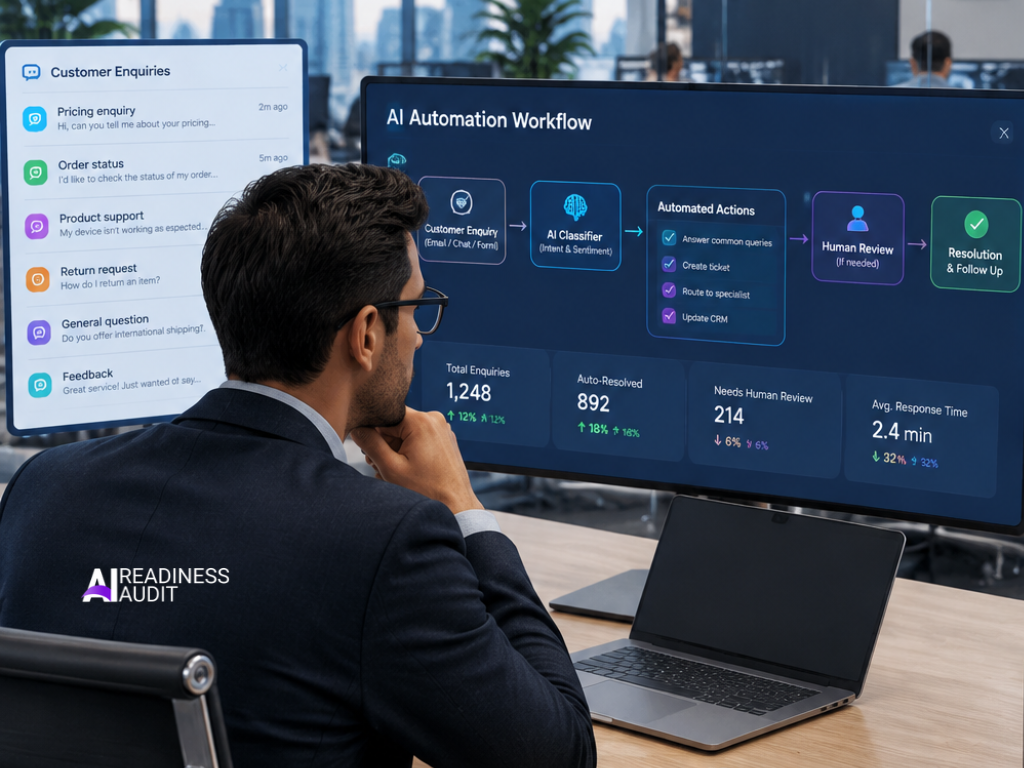
An effective AI automation strategy should account for the practical requirements of the business and the environment in which it operates.
Although organisations across Australia face many similar technology decisions, their industry, location, available workforce and operational systems may influence which approach is more suitable.
Businesses researching AI automation services should focus on these requirements rather than assuming that a particular state or territory requires a completely different AI strategy.
AI Planning Across NSW, Queensland and Victoria
For organisations developing an AI automation strategy in New South Wales, the most relevant considerations often involve existing business systems, workflow complexity and the availability of implementation support.
A Sydney professional services firm might need to connect client enquiries, document management and CRM records.
Meanwhile, a regional NSW business may place greater importance on solutions that can be supported remotely and operate alongside its current software.
Businesses developing an AI automation strategy in Queensland may face different operational requirements depending on their sector.
For example, tourism operators may be interested in enquiry management and booking workflows, while agricultural or service businesses may need to organise information received from multiple locations.
The same decision principles apply: review existing software before investing in a new platform or commissioning development.
AI Automation Strategy Victoria, manufacturers, logistics providers, retailers and professional firms may have opportunities to improve document handling, inventory-related workflows and customer communications.
However, the suitability of AI depends on the specific process and available information.
Across these states, organisations should compare ready-made platforms with custom integrations based on the business problem rather than geographic assumptions.
AI Adoption in WA, Tasmania, the NT and the ACT
An AI automation strategy in Western Australia may need to consider specialised workflows associated with resources, engineering, mining services or businesses operating across distant locations.
For example, a company with remote teams may want to improve how operational reports and documents move between employees and central systems.
In AI Automation Strategy Tasmania, smaller organisations working in tourism, agriculture or food production may prefer tools that integrate with existing business applications without requiring extensive internal technical resources.
For businesses in the Northern Territory, remote operations, service coordination and reliable access to information can influence software decisions.
An organisation may need to assess connectivity, offline working requirements and support arrangements before implementing cloud-based automation.
The AI Automation Strategy Australian Capital Territory also presents different operational considerations, particularly for professional services and organisations working with government clients.
These businesses may need to account for contractual security requirements, information handling and approval processes.
Such requirements are not automatically identical across every organisation in the ACT.
Whether the business is located in AI Automation Strategy Western Australia, Tasmania, the AI Automation Strategy Northern Territory or the ACT, its AI automation strategy should reflect the work being performed and the systems supporting that work.
An Australian-wide approach can provide consistent principles while allowing individual organisations to address their operational and sector-specific needs.
How to Evaluate AI Providers Before Making a Decision
Choosing a suitable provider is an important part of implementing AI automation services.
Businesses may work with software vendors, technology consultants, system integration specialists or custom development teams.
However, not every provider offers the same capabilities or ongoing support.
The best option should be able to explain how the proposed solution addresses the business’s actual requirements.
Questions to Ask AI Software Vendors and Developers
Before selecting a provider, businesses should understand what is included in the proposed service.
For an existing AI platform, it is useful to examine supported integrations, user permissions, data-handling practices and ongoing subscription requirements.
If custom development is being considered, businesses should ask how the solution will connect with current systems and who will maintain it after deployment.
It is also important to understand whether the provider has experience with the relevant software and business processes.
Some AI automation companies specialise in connecting existing applications, while others focus on custom applications, predictive analytics or AI agents.
A provider offering advanced AI tools is not necessarily the best choice for a business that only needs simple workflow automation.
Ask how the solution handles unexpected information, incomplete records and processing errors.
Businesses should also understand who owns the software, who controls the data and what happens if the commercial relationship ends.
Where AI-generated information could influence important decisions, the provider should explain how outputs will be reviewed and tested.
A clear explanation of limitations is often more useful than broad promises about what artificial intelligence can achieve.
Why an AI Readiness Assessment Should Come First
Before purchasing or building AI software, businesses can benefit from understanding how prepared their existing operations are for automation.
An AI readiness assessment examines areas such as business systems, data quality, workflow design, governance and employee capabilities.
This can identify practical obstacles that should be addressed before implementation.
For example, a business may want to automate customer follow-ups but discover that customer details are stored inconsistently across several platforms.
Introducing an AI agent without resolving these records may create additional errors.
Similarly, a company considering document automation may first need to standardise how information is received, stored and approved.
AI Readiness Audit provides assessments that review business systems, data, workflows, governance and team capability to help organisations identify readiness gaps and opportunities.
Its services also include AI consulting and strategy, AI-powered automation and custom AI development.
For businesses comparing AI automation services, this type of assessment can help clarify whether an existing product, a custom integration or a more specialised solution is appropriate.
The aim is to establish practical requirements before making a technology investment.
Making a Practical Build-or-Buy Decision
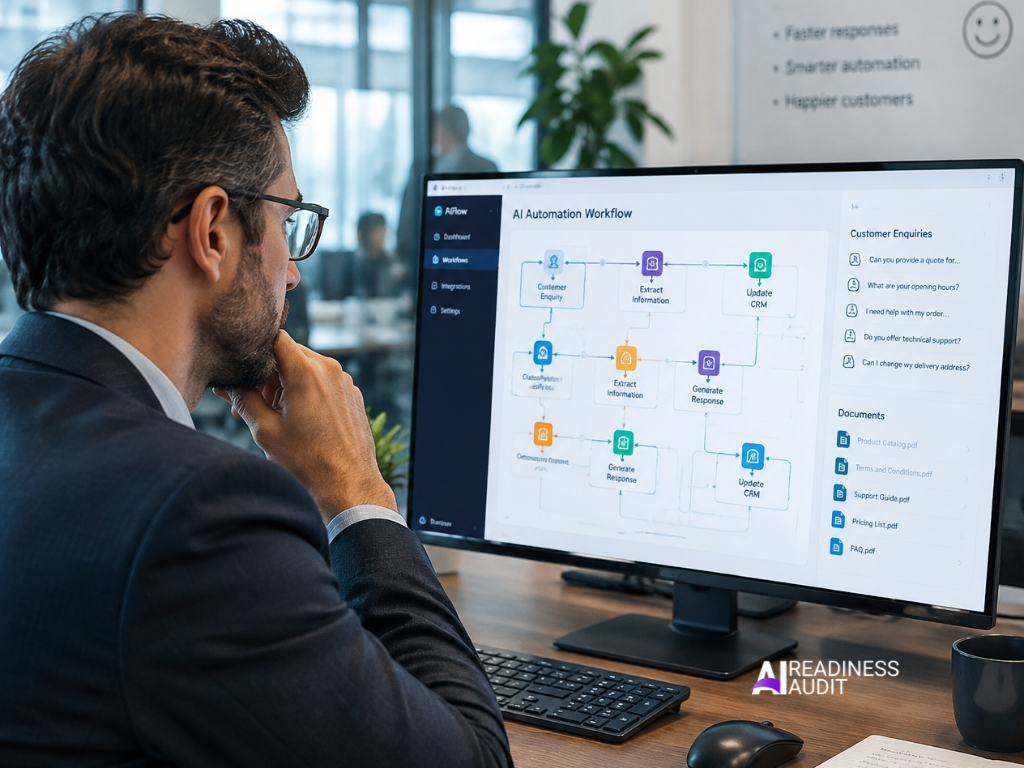
There is no single answer to whether a business should build or buy AI tools.
The most suitable approach depends on what needs improving, the complexity of the workflow and the resources available to implement and maintain the solution.
For Australian organisations, a sensible decision should balance functionality, costs, security and long-term operational value.
Using AI Automation Strategy Australia to Compare Options
When existing software already provides the required functionality, purchasing or configuring a ready-made solution is often the simplest starting point.
This may be appropriate for common tasks such as meeting summaries, customer enquiry routing or standard CRM automation.
Custom development becomes more relevant when a business has specialised requirements that cannot be addressed effectively through available tools.
These may include unique internal workflows, complex approval processes or integrations with specialised business systems.
However, businesses do not always need to choose one approach exclusively.
A hybrid model can combine an established AI automation platform with custom integrations or internal applications.
For example, a company might use existing AI services to extract information from documents while developing a tailored interface to review and transfer the results into its project management system.
This approach can preserve useful existing software while addressing specific operational gaps.
When comparing options, consider the quality of the output, integration requirements, staff involvement, security controls and ongoing maintenance.
The most advanced solution is not necessarily the most suitable one.
A useful AI automation strategy for Australia should prioritise reliable business outcomes over unnecessary technical complexity.
Starting With a Small Project Before Scaling Up
Once a business has selected an approach, beginning with a manageable project can help test its suitability.
A practical starting point is a workflow that occurs regularly, has clearly defined inputs and can be measured against the existing process.
For example, a business could test automation for organising incoming customer enquiries.
The initial project might identify enquiry types, extract relevant information and prepare records for employee review.
Before expanding the solution, the organisation can evaluate whether the information is accurate, whether employees spend less time on repetitive tasks and whether unexpected situations are handled appropriately.
If the results are useful, the workflow can be refined and expanded gradually.
If the process requires frequent corrections or introduces new complications, it may need further adjustment before broader implementation.
Businesses should also involve employees who understand the existing workflow.
Their experience can help identify exceptions, missing information and practical requirements that may not be obvious during initial planning.
For organisations still deciding where to begin, reviewing existing processes through an AI readiness assessment can help identify suitable opportunities and the preparation required before implementation.
Ultimately, the decision to build or buy AI tools should not be driven by technology trends alone.
It should be based on the organisation’s requirements, available resources and ability to manage the solution over time.
By evaluating existing platforms, custom development and hybrid approaches, Australian businesses can select AI automation services that support their operations without introducing unnecessary costs or complexity.
