

Australia is putting greater emphasis on domestic manufacturing as the country expands renewable energy, battery supply chains, critical minerals processing and lower-emissions metals. Under the current Future Made in Australia agenda, clean-energy manufacturing, green metals and critical minerals processing are among the priority areas receiving government attention and investment.
Behind these large industries are many smaller manufacturing requirements. Electrical equipment may need cabinets and covers. Control systems need mounting plates and enclosures. Industrial equipment can require brackets, panels, guards and other fabricated components. These are the types of applications where cnc sheet metal fabrication can form part of the wider manufacturing supply chain.
That does not mean every sheet-metal fabricator automatically works on clean-energy projects, nor does it mean every clean-energy system needs the same components. The connection is broader: as Australian manufacturing becomes more technically demanding, manufacturers increasingly need repeatable ways to turn digital designs into accurate metal parts.
For engineers, designers and procurement teams, understanding the role of CNC cutting, punching, bending and fabrication can make it easier to plan components that are practical to manufacture and suitable for repeat production.
See where sheet metal fits into modern industrial equipment
Clean-energy manufacturing is much broader than solar panels or batteries themselves.
The equipment surrounding these technologies may require protective housings, electrical cabinets, equipment panels, brackets, mounting plates, guards, covers and structural supports. Similar fabricated components can also be required around processing machinery, control equipment and industrial systems.
This creates a practical role for cnc sheet metal fabrication.
A manufacturer can begin with flat sheet, cut or punch the required geometry, form the material into shape and then continue with welding, fasteners, finishing or assembly where required.
The Australian Government currently identifies clean-energy manufacturing, including battery supply chains, alongside green metals and critical minerals processing as priority manufacturing areas. Its National Battery Strategy also aims to increase Australian battery and component manufacturing capability.
Sheet-metal businesses should not interpret this as a guarantee of work from those sectors. However, it does demonstrate why strong local manufacturing capability remains relevant as Australia develops more industrial equipment and supporting infrastructure.
Understand why repeatability matters as production grows
A prototype only needs to prove that a design works once.
Production is different.
If a cabinet requires eight mounting brackets, every bracket needs to align correctly. If the same enclosure is produced repeatedly, the holes, folds and overall geometry need to remain consistent enough for downstream assembly.
This is where CNC manufacturing becomes useful.
The equipment follows programmed information derived from the production drawing, allowing the same geometry to be reproduced across multiple parts. The quality of the finished result still depends on good design, setup, material and process control, but CNC production reduces reliance on manually recreating every feature from scratch.
Repeatability becomes particularly important for high-precision sheet metal parts that must connect with electrical equipment, doors, fasteners, frames or other components.
The design should therefore identify which dimensions actually matter.
A decorative outer panel may tolerate more variation than a mounting plate whose holes must align with equipment installed later.
Recognising those differences early can prevent the manufacturing specification from becoming unnecessarily difficult while still protecting the features that are important to the finished assembly.
See How CNC Processes Turn Digital Designs Into Finished Parts
CNC manufacturing begins before any metal reaches the machine.
A usable production drawing should communicate the component’s size, material, thickness and important dimensions. It may also need to show hole positions, bend locations, tolerances, finishes and assembly requirements.
This digital preparation is especially important when a part will pass through several manufacturing stages.
A flat component might first be laser cut, then folded, welded and powder coated. If the designer considers only the original flat profile, a hole could end up too close to a bend or an enclosure may not assemble as expected.
Good design therefore looks ahead.
Premier Engineering’s current manufacturing capabilities include CAD and prototyping alongside its cutting, punching and forming services, reflecting the connection between design preparation and later production.
For customers, this means sending a complete drawing is usually more useful than sending a photograph and asking for something similar.
The fabricator needs enough information to understand not only what the part looks like but also how it needs to function.
Use CNC equipment for consistent repeat production
Once the production information has been prepared, CNC machinery can reproduce the programmed geometry.
Depending on the component, the manufacturing process might involve laser cutting, punching, bending or several operations.
This is useful when a business needs one prototype followed by a later production run because the approved digital design provides a defined starting point for subsequent parts.
However, CNC does not mean every component automatically becomes perfectly identical.
Material properties, bend behaviour, tooling and tolerances still matter.
For example, sheet metal changes shape during bending. A manufacturer therefore needs to consider bend allowance, material thickness and tooling rather than assuming the flat drawing will simply fold into the exact finished dimensions.
The practical benefit of CNC production is controlled repeatability.
Once a design has been reviewed and a workable production method established, the same programmed process can be reused more reliably than repeatedly manufacturing the component from an informal sketch.
That can be valuable for replacement components and production batches as well as new industrial equipment.
Match Cutting and Punching Methods to the Component
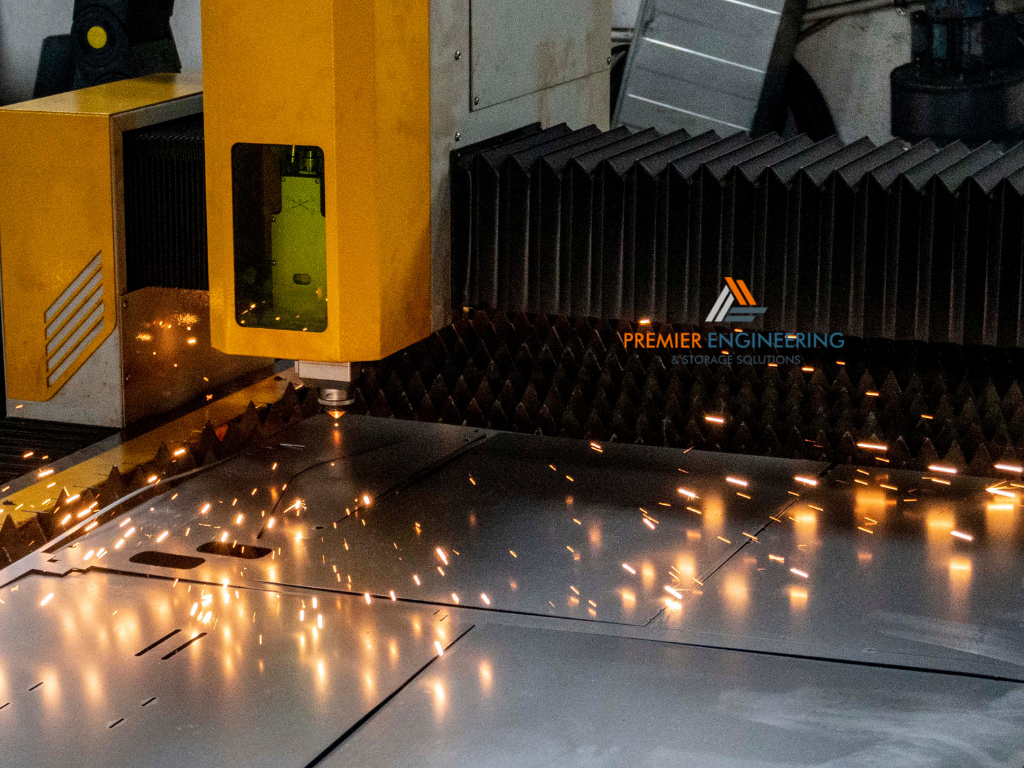
Use CNC cutting for complex profiles and changing designs
CNC cutting services can be particularly useful when a sheet-metal component contains a complicated external profile, varying hole shapes or geometry that may change during development.
Laser cutting is one common approach.
Instead of using a physical cutting tool to follow the edge of the component, a suitable industrial laser follows the programmed geometry. This allows detailed sheet-metal profiles to be produced without requiring dedicated cutting tooling for every new outline.
That can be useful during development because design revisions may be made in the digital file.
However, laser cutting should not automatically be specified for every sheet-metal component.
The appropriate process depends on the material, thickness, part geometry, quantity and what happens after cutting.
Someone designing an enclosure, for example, should also consider whether the flat panels need folding, fastening or welding. The cutting stage is only part of the manufacturing sequence.
The strongest production decision therefore comes from considering the complete component rather than selecting a machine first.
Consider punching for repeated holes, slots and formed features
A cnc punching service can make sense when sheet-metal components contain repeated features that suit available punch tooling.
Consider an equipment panel containing a regular arrangement of ventilation openings, mounting holes or slots.
Rather than treating every feature as a completely different contour, a CNC turret punch can repeatedly produce suitable features according to the programmed pattern.
Premier Engineering’s current CNC punching information describes its turret punching capability as particularly relevant where surfaces contain a higher density of holes, and its broader manufacturing service includes both punching and laser cutting.
Metal punching services therefore should not be viewed as an outdated alternative to laser cutting. They solve a different production problem.
For some designs, laser cutting may be more practical.
For others, punching may suit the repeated geometry.
In some manufacturing environments, process selection may also consider available tooling, quantities, material thickness and later forming.
The customer does not necessarily need to make this choice alone. Providing the complete drawing allows the fabricator to assess which process better matches the part.
Choose Materials Around the Operating Environment
Material choice affects much more than appearance.
Mild steel can suit many structural and general fabrication applications and can be finished in different ways depending on the environment.
Stainless steel may be considered when corrosion resistance, durability or a particular finish is important.
Aluminium can provide lower weight and natural corrosion resistance, making it useful in applications where reducing component mass matters.
There is no universally superior material.
An indoor control cabinet may have different requirements from an outdoor equipment housing. A bracket carrying a significant load has different priorities from a lightweight access panel.
The fabrication process also needs to suit the selected metal.
Different materials behave differently during cutting, punching and bending, and material thickness affects the tooling and process settings required.
For that reason, a quote request should ideally identify the material grade where the engineering specification requires one rather than simply asking for “metal”.
When the grade is not known, explaining the operating environment and intended use gives the supplier more context for the conversation.
Know when CNC stainless steel fabrication may be useful
Cnc stainless steel fabrication can be relevant when a component needs the properties of stainless steel together with repeatable cutting, punching or forming.
For example, a fabricated enclosure used in a demanding environment may place more emphasis on corrosion resistance than an internal component protected from weather.
However, stainless steel should not be selected simply because it sounds more durable.
It can differ from mild steel in cost, forming behaviour, finish and manufacturing requirements.
The complete design needs to justify the material.
The same principle applies in Australia’s developing clean-energy industries.
Government policy currently identifies low- and near-zero-emissions steel and aluminium among the country’s green-metals opportunities, while recognising that decarbonising metals production is itself a major industrial challenge.
For individual fabricated components, however, designers still need to choose materials based on engineering requirements.
A cleaner manufacturing economy does not remove the need to consider strength, corrosion, weight, fabrication and service conditions.
Material selection and manufacturing method should therefore be planned together.
Plan Bending and Assembly From the Beginning
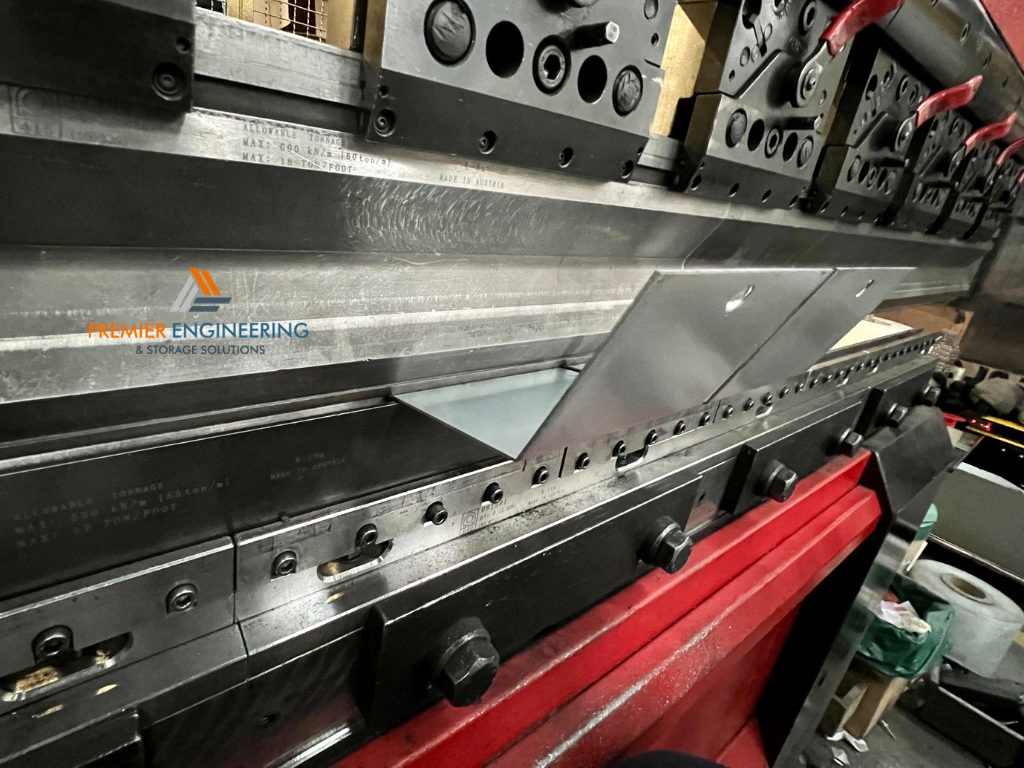
Design parts with press-brake forming in mind
Many useful sheet-metal components do not remain flat.
A panel may need a flange. A bracket may require several bends. An enclosure can begin as a flat sheet before being formed into a three-dimensional component.
A metal bending press, commonly a press brake, produces these bends by applying force through suitable punch-and-die tooling.
This stage needs to be considered when the original drawing is developed.
If a hole is located too close to a bend, forming may affect it. If bend radii and material thickness are ignored, the finished dimensions may differ from what the designer expected.
The flat pattern and final folded component are therefore closely connected.
Premier Engineering currently lists CNC brake-press bending as one of its manufacturing capabilities and identifies AMADA HG press brakes within that service.
For customers, the important point is not the machine brand.
It is that the cutting and bending stages need to be planned as one manufacturing sequence.
Think about welding, fasteners and finishing as one workflow
A finished industrial component can pass through several manufacturing stages after cutting.
An enclosure may require bending and welding.
A removable panel might need inserted fasteners.
External equipment could require an appropriate protective finish.
A completed cabinet might also need several separately fabricated parts assembled together.
If these later requirements are known from the beginning, the earlier manufacturing stages can be planned around them.
For example, the designer can include correct fastener locations before the sheet is cut rather than drilling them later as an afterthought.
Similarly, components that will be welded together need compatible geometry and access for the welding process.
Premier Engineering currently lists fastener insertion, welding, powder coating and several other finishing-related services alongside cutting and forming.
This type of integrated manufacturing sequence can be relevant to clean-energy equipment because fabricated sheet-metal components are often part of a larger assembly rather than stand-alone flat pieces.
The manufacturing conversation should therefore begin with the finished requirement.
Choose the Right Fabrication Process for the Project
There is no single CNC process that suits every sheet-metal part.
A component with a complex outline may suit laser cutting.
A panel with many repeated openings may be a candidate for CNC punching.
A folded enclosure requires press-brake work after the flat part has been produced.
A completed assembly may also need fasteners, welding or finishing.
The best manufacturing path depends on how these requirements interact.
Quantity can influence the decision too.
A process that works efficiently for a changing prototype may not be the preferred method for a stable design containing repeated features across a larger run.
Likewise, unnecessarily tight tolerances can complicate production without improving the component’s function.
When sourcing cnc cutting services western Sydney businesses should therefore provide enough information for the supplier to assess the whole job rather than requesting one particular machine process before the design has been reviewed.
The relevant questions are what the component is made from, what geometry it needs, how accurately critical features must fit, how many parts are required and what operations follow cutting.
Look for a supplier that can support the required production stages
A supplier does not need to provide every manufacturing process imaginable.
It needs to provide the processes your component actually requires, either directly or through clearly managed arrangements.
For a project involving cutting, punching and forming, sourcing each stage independently can also mean that responsibility for manufacturability is divided between several businesses.
An integrated workflow can instead allow the manufacturing sequence to be considered earlier.
Premier Engineering is based in Ingleburn in South-West Sydney and currently lists design, prototyping, laser cutting, CNC punching, CNC brake press, fastener insertion, welding, powder coating and related manufacturing capabilities.
That makes the company relevant when a sheet-metal project requires several of those verified processes.
However, this should not be interpreted as a claim that Premier Engineering currently manufactures components for particular battery, solar, hydrogen or other clean-energy projects. No specific project evidence has been used here.
The practical reason to contact a multi-process fabricator is simpler: the design can be reviewed against the actual manufacturing stages it needs.
Speak With a Fabricator Before the Design Reaches Production
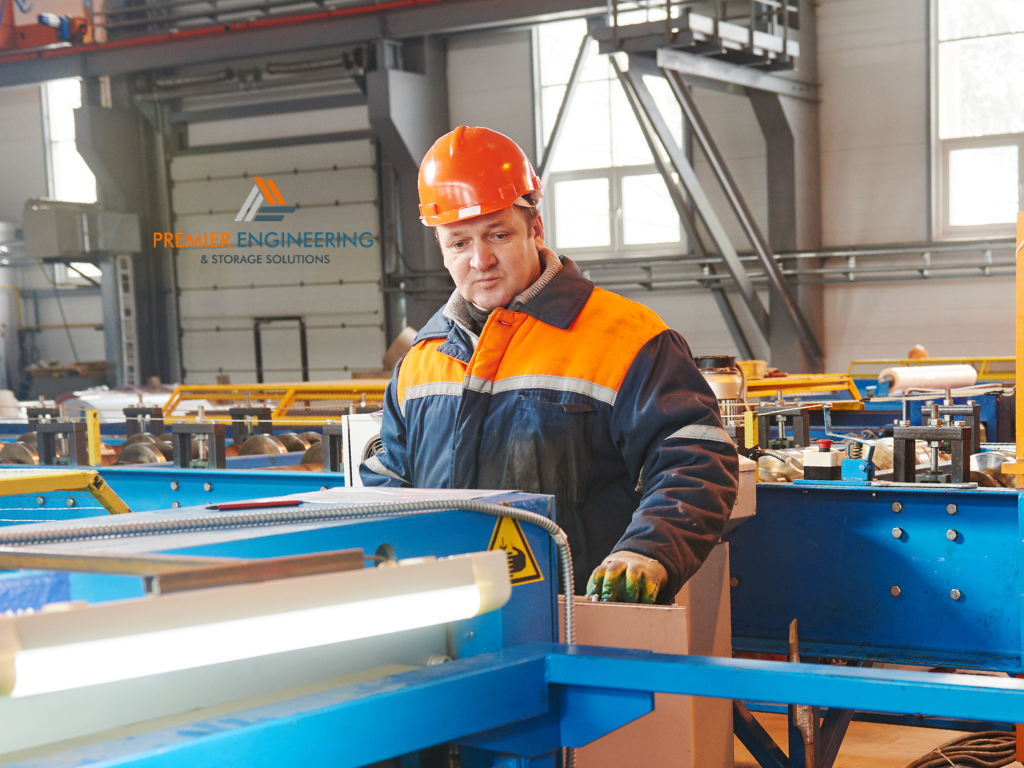
Provide enough technical information for the job to be reviewed
A good fabrication enquiry begins with more than a request for a price.
Provide a drawing or CAD file where possible.
Identify the material and thickness if they are already specified.
Include the required quantity and note any dimensions that are particularly important.
If a component has to fit another part, explain that too.
The finished use provides valuable context.
A decorative cover may have different tolerance requirements from a bracket that positions electrical equipment.
An indoor panel may require a different material or finish from equipment exposed to weather.
If the component will later be bent, welded or assembled, those details should be included before the cutting method is selected.
Premier Engineering’s current quote form asks for information including quantity, material, size, a message and uploaded files, which reflects the value of providing practical production details from the beginning.
Clear project information gives the fabricator a better chance to identify problems before metal is processed.
Contact the company when process choice or manufacturability is unclear
You do not need to decide every machine operation before speaking with a fabricator.
In fact, early discussion can be particularly useful when a component combines several manufacturing requirements.
Perhaps you know the finished shape but are unsure whether repeated features favour a cnc punching service or laser cutting.
You may have selected stainless steel but want to understand how the material affects forming.
A prototype may work, but you now need to prepare it for repeat production.
These are situations where manufacturing input can help.
Premier Engineering can be contacted for projects that match its verified sheet-metal capabilities, including design, prototyping, CNC punching, laser cutting, brake-press forming and associated fabrication processes.
Australia’s clean-energy manufacturing growth provides the broader context. Government policy is supporting areas such as battery manufacturing, critical minerals processing and green metals as part of efforts to strengthen domestic industrial capability.
CNC sheet metal fabrication is not the entire clean-energy supply chain, nor should every fabricator claim to be part of a project simply because its equipment could make a relevant component.
Its role is more practical.
Modern industrial systems need accurately manufactured physical parts. CNC cutting, punching and forming provide ways to turn engineering designs into repeatable panels, brackets, cabinets, enclosures and other components.
For Australian manufacturers preparing for new industrial opportunities, the strongest approach is to design with production in mind from the beginning, choose materials around the real operating environment, and involve the fabricator early enough to identify a sensible manufacturing path.
