

A ride on mower makes maintaining larger lawns and acreage properties more manageable, but regular maintenance is important for keeping the equipment in good working condition. From engine oil and cutting blades to tyres, drive belts and batteries, different components need attention throughout the mower’s operating life.
For Australian homeowners and property owners, mowing conditions can vary significantly. Dusty acreage, thick grass, uneven ground and periods of rapid summer growth can place different demands on lawn equipment.
Without appropriate maintenance, grass clippings can accumulate around the cutting deck, filters may become restricted and worn components can affect cutting performance or handling.
However, maintaining a ride-on mower does not mean every task requires professional assistance.
Many routine inspections and basic cleaning activities can be completed by owners who follow the manufacturer’s instructions. More complicated servicing, particularly work involving engines, transmissions or damaged mechanical components, may require a qualified technician.
Understanding what to check, when to arrange servicing and which warning signs should not be ignored can help owners manage their equipment more responsibly.
Why Regular Ride On Mower Maintenance Matters
Routine maintenance helps identify wear and operating problems before they become more disruptive.
A mower may continue operating while its cutting blades gradually lose sharpness or debris accumulates around the deck.
These problems can affect the appearance of the lawn and may place additional demands on the machine.
For example, damaged or unbalanced cutting blades may cause vibration or produce an uneven cut.
Low tyre pressure may affect mower handling and cutting consistency.
Restricted air filters can affect engine performance, particularly when mowing in dusty environments.
Regular inspections provide an opportunity to identify these conditions and arrange suitable maintenance.
Maintenance is also important for safe operation.
Steering, braking, blade engagement systems and other safety-related components should function according to the manufacturer’s specifications.
If the mower begins behaving unexpectedly, continuing to operate it may increase the risk of further damage or injury.
Although maintenance can reduce avoidable problems, it cannot prevent every mechanical failure.
Components eventually wear through normal use, and unexpected faults may still occur.
The objective is to maintain the machine according to its intended operating requirements and respond appropriately when something changes.
Understanding Daily, Seasonal and Scheduled Servicing
Ride-on mower maintenance generally involves different levels of attention.
Before mowing, owners should inspect the equipment and operating area for visible problems.
This may include checking tyres, looking for fluid leaks, reviewing fuel or battery condition and confirming that safety-related controls appear to be functioning normally.
The exact checks depend on the mower model.
After mowing, removing grass accumulation and checking for visible damage can help maintain equipment condition.
Periodic servicing may involve additional work such as replacing engine oil, inspecting filters, examining drive systems and assessing cutting components.
Many manufacturers specify maintenance intervals using operating hours, calendar periods or whichever comes first.
For example, Husqvarna publishes maintenance guidance covering checks around 50, 100 and 200 operating hours for relevant ride-on mower types.
However, these intervals should not be treated as universal instructions for every mower.
Different engines, transmissions and equipment designs can have different service requirements.
A mower used frequently on dusty acreage may also require more attention than one used occasionally on a clean, maintained lawn.
Owners should keep their operator manual accessible and record completed servicing.
This provides a clearer picture of maintenance history and helps identify when further work is due.
Checking the Engine, Oil and Fuel System
Engine maintenance is one of the most important responsibilities associated with a petrol-powered ride on mower.
The engine operates under changing loads as the mower moves through grass of different heights and densities.
Correct lubrication, suitable fuel and clean air filtration help support reliable operation.
However, engine servicing should always follow the specifications supplied by the mower or engine manufacturer.
Engine Oil, Air Filters and Spark Plug Maintenance
Engine oil lubricates moving components and helps reduce friction during operation.
If the oil level becomes too low or the lubricant deteriorates beyond its service requirements, engine components may experience increased wear.
Owners should check oil levels according to the relevant operator manual.
For many machines, this involves positioning the mower on level ground, stopping the engine and following the manufacturer’s dipstick procedure.
Oil changes should use the recommended lubricant type, quantity and service interval.
Adding an unsuitable oil or overfilling the engine can create problems.
Air filters also require attention.
A ride-on mower operating on dry or dusty Australian properties may encounter airborne grass particles and soil dust.
Over time, these materials can restrict an air filter.
Some filters can be cleaned according to manufacturer instructions, while others require replacement.
Cleaning methods differ, and certain filter materials should not be washed or exposed to compressed air.
Spark plugs are another component that may require inspection or replacement during scheduled servicing.
A worn or fouled spark plug can contribute to starting or running difficulties, although similar symptoms may have other causes.
Rather than replacing components based on guesswork, owners should follow the servicing schedule and investigate persistent problems appropriately.
Preventing Fuel Problems and Starting Difficulties
Fuel condition can affect a petrol mower’s ability to start and operate correctly.
Petrol stored for extended periods may deteriorate, while contamination can affect the fuel system.
The likelihood of problems depends on the fuel type, storage conditions and equipment design.
Owners should use the fuel recommended by the manufacturer and store it in approved containers under suitable conditions.
A mower that is not used regularly may require additional preparation before extended storage.
Some manufacturers specify procedures involving fuel management, while others may permit particular stabilising products when used according to instructions.
These recommendations should not be generalised across every machine.
Starting difficulties can also involve the battery, electrical connections, ignition system or safety interlocks.
For example, a mower may not start if a required safety condition has not been met.
Before assuming there is an engine fault, the operator should consult the manual and check the relevant starting requirements.
If the mower repeatedly fails to start, produces unusual sounds or shows signs of fuel leakage, professional inspection may be appropriate.
Fuel system repairs and electrical diagnosis should not be attempted without suitable knowledge and equipment.
Maintaining Cutting Blades and the Mower Deck
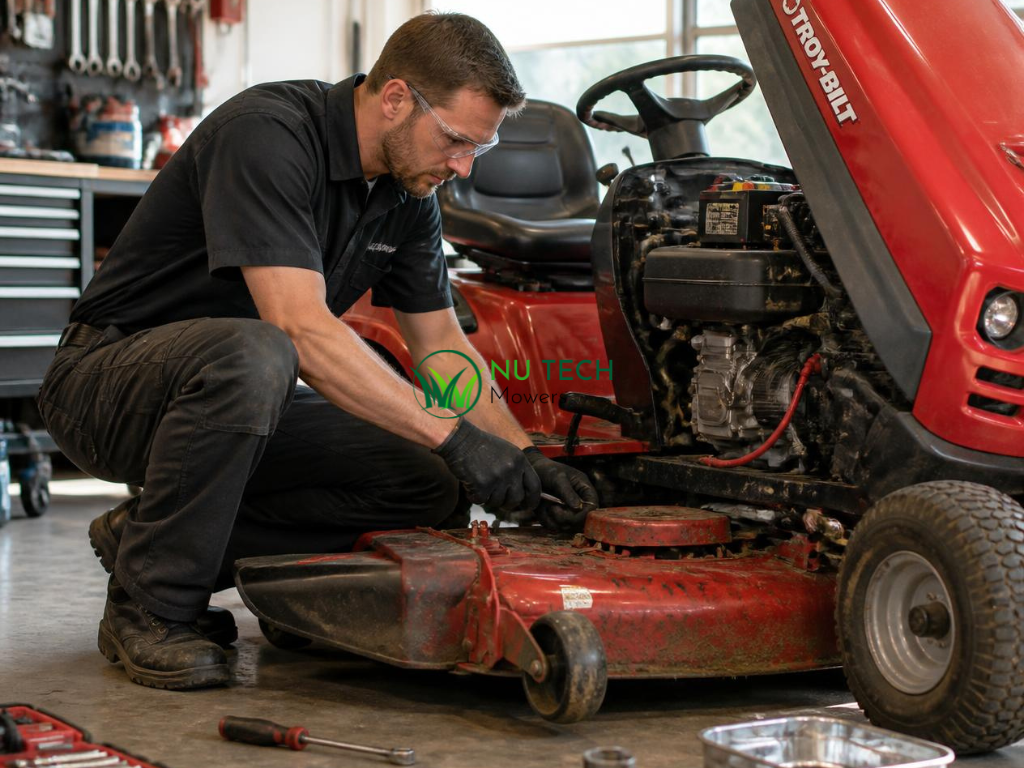
The cutting system directly influences the quality of the finish produced by a ride on mower.
Even when the engine and drive system operate normally, damaged blades or excessive debris around the deck can affect mowing results.
Regular inspection and appropriate cleaning help owners recognise problems before they become more significant.
When to Inspect and Replace Ride On Mower Blades
Cutting blades gradually wear through use.
Their condition can be affected by grass density, mowing frequency and contact with objects such as stones or branches.
A blade with a worn cutting edge may tear grass rather than cut it cleanly.
This can create an uneven or ragged lawn appearance.
More serious blade damage may occur after contact with hard objects.
Bent, cracked or unbalanced blades can create vibration and potentially damage other mower components.
Owners should pay attention to sudden changes in cutting performance or unusual vibration during operation.
These symptoms require investigation before continued use.
Blade inspections must be carried out with the mower fully stopped and secured according to its manual.
Owners should never reach underneath an operating mower or attempt to handle blades while the equipment could start unexpectedly.
Some mower designs provide an approved service position for inspecting cutting components.
However, the correct method varies.
Husqvarna advises that damaged or unbalanced ride-on mower blades should be replaced using compatible parts.
Blade sharpening and balancing should also be performed correctly.
If an owner lacks the necessary equipment or experience, professional assistance is the safer option.
Using incompatible blades or incorrect installation procedures can create serious hazards.
Cleaning the Cutting Deck and Preventing Grass Build-Up
Grass clippings can accumulate around the underside of a cutting deck.
This is particularly common when mowing thick or damp grass.
Over time, excessive build-up may interfere with cutting performance and contribute to corrosion in vulnerable areas.
Owners should follow the manufacturer’s instructions for cleaning the deck.
Some machines have approved cleaning procedures or service positions designed to provide suitable access.
Others require different arrangements.
It is important not to assume that every mower can be pressure-washed or cleaned using the same method.
High-pressure water may damage bearings, electrical components or other sensitive areas if applied incorrectly.
Before cleaning, the mower should be stopped, secured and allowed to reach a safe condition.
If the cutting deck must be raised or repositioned, only manufacturer-approved procedures should be used.
Never work underneath equipment that is unsupported or improperly secured.
Cleaning also provides an opportunity to inspect the deck for visible cracks, corrosion, loose components and other signs of damage.
If a deck produces unusual noises or appears structurally damaged, it should be assessed before further mowing.
Maintaining the cutting system helps support an even finish and provides an opportunity to identify developing mechanical problems.
Looking After Tyres, Belts and Moving Components
A ride on mower relies on several mechanical systems to move, steer and operate its cutting equipment.
Tyres, steering components, drive belts and transmissions can affect both handling and mowing performance.
These components should be considered during routine inspections and scheduled servicing.
Tyre Pressure, Steering and Ride On Mower Handling
Correct tyre pressure can influence ride-on mower handling and cutting consistency.
If tyre pressures differ significantly from the manufacturer’s recommendations, the mower may sit unevenly.
This can affect the relationship between the cutting deck and the ground.
Owners should check tyre pressure using an appropriate gauge and compare the readings with their model’s specifications.
The correct pressure may differ between front and rear tyres.
Tyres should also be inspected for visible cracks, punctures, damage and unusual wear.
A tyre that repeatedly loses pressure may require repair or replacement.
Steering behaviour is equally important.
A mower that becomes difficult to steer, pulls unexpectedly or develops excessive movement in its controls should be inspected.
These symptoms may involve several possible causes and should not be attributed to a single component without appropriate diagnosis.
Operating conditions also affect handling.
Wet grass, loose soil and steep terrain can reduce traction.
A properly maintained mower must still be operated within the manufacturer’s slope and terrain limitations.
Tyre condition and steering maintenance support safe operation, but they do not make unsuitable ground safe to mow.
Drive Belts, Bearings and Transmission Maintenance
Drive belts transfer power between relevant components on many ride-on mower designs.
Depending on the machine, belts may be used for propulsion, cutting deck operation or both.
Over time, belts can wear, stretch or become damaged.
Possible warning signs include unusual noises, slipping, inconsistent blade operation or changes in mower movement.
However, these symptoms may also involve pulleys, bearings, tensioning systems or other mechanical components.
A visual inspection may identify obvious wear, but more complex diagnosis should be performed by someone familiar with the equipment.
Owners should not attempt to inspect or adjust moving belts while the machine is operating.
Husqvarna advises that certain cutting belt problems require authorised dealer attention.
Transmission maintenance is another area where requirements differ significantly between models.
Some mower transmissions have specified fluid checks or replacement procedures.
Others contain sealed assemblies with different service requirements.
Assuming that every transmission uses the same oil or maintenance schedule can cause damage.
If the mower struggles to move, behaves unpredictably or develops unusual transmission noise, it should be assessed before continued use.
Professional servicing may be necessary where repairs involve complex drive components or specialised tools.
Battery Care and Seasonal Mower Preparation
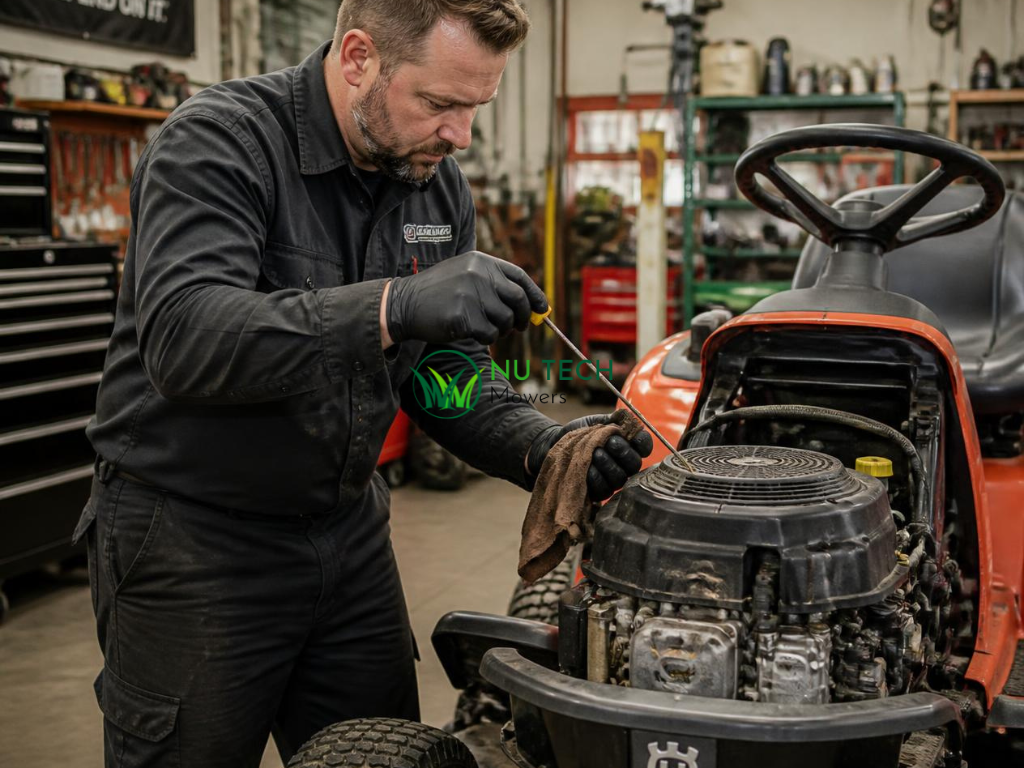
Battery condition and seasonal operating conditions can affect the reliability of a ride on mower.
A machine used frequently throughout spring and summer may experience different maintenance demands from one stored for extended periods.
Australian homeowners should consider both the mower’s power system and the conditions in which it operates.
Battery Maintenance and Electrical System Checks
Many petrol-powered ride-on mowers use a battery to start the engine and support electrical functions.
A weak or discharged battery can create starting difficulties even when the engine itself is in suitable condition.
Owners should follow the manufacturer’s recommendations for charging, storage and inspection.
Visible corrosion around terminals, damaged cables or loose connections may require attention.
However, electrical repairs should not be attempted without the necessary knowledge and safety precautions.
Battery-powered ride-on mowers have different requirements.
Their propulsion systems may depend on larger rechargeable battery arrangements, electronic controls and dedicated charging equipment.
These components require model-specific handling and maintenance.
Owners should use approved chargers and avoid exposing batteries to unsuitable storage or charging conditions.
Damaged, swollen, leaking or unusually hot batteries should not be used or charged.
Professional assessment is appropriate when battery or charging system faults are suspected.
Battery maintenance principles also apply to other garden equipment, including suitable cordless push mowers and trimmers.
However, compatibility should never be assumed merely because products are made by the same brand.
Preparing Your Ride On Mower for Seasonal Changes
Seasonal conditions can influence mower maintenance requirements across Australia.
During warmer growing periods, grass may grow rapidly and require more frequent mowing.
This can increase operating hours and expose the mower to greater amounts of clippings and debris.
In dry conditions, airborne dust may increase the need to inspect filtration systems.
During wetter periods, grass can accumulate more heavily around the cutting deck.
Owners should adjust maintenance attention according to actual conditions while following the manufacturer’s schedule.
Extended periods of reduced use also deserve consideration.
Before storing a mower, it is sensible to review the manufacturer’s guidance on cleaning, fuel preparation, battery care and suitable storage conditions.
Some machines require particular procedures to protect their fuel systems or batteries during long periods without operation.
A mower stored outdoors may also be exposed to moisture, sunlight and changing temperatures.
Where practical, equipment should be kept in a suitable sheltered location that follows the manufacturer’s storage requirements.
Before returning the mower to regular use, owners should inspect its condition and confirm that required servicing has been completed.
This may include checking tyres, fluids, batteries, cutting equipment and safety-related controls.
Seasonal preparation helps reduce the likelihood of discovering avoidable problems during the first mowing session after storage.
Recognising Maintenance Problems Before They Become Repairs
Understanding common warning signs can help ride on mower owners recognise when equipment requires attention.
Not every unusual sound or performance change indicates a serious fault, but unexpected behaviour should not be ignored.
Early inspection can help identify maintenance needs and determine whether professional diagnosis is appropriate.
Common Signs Your Ride On Mower Needs Attention
Difficulty starting is a common concern.
Possible causes include battery condition, fuel problems, ignition components or safety-related starting requirements.
Because several systems can produce similar symptoms, owners should avoid making assumptions without suitable checks.
Uneven cutting is another warning sign.
This may involve blade condition, tyre pressure, deck settings or grass conditions.
A mower that produces a poor finish despite appropriate cutting height and operating conditions may need closer inspection.
Excessive vibration deserves particular attention.
Damaged blades, loose components or other mechanical problems can create vibration that affects the machine’s operation.
If vibration becomes unusually strong or begins suddenly, mowing should stop until the cause has been assessed.
Unexpected changes in steering, braking or drive performance may also indicate faults that require attention.
Likewise, unusual smells, smoke, fuel leaks or overheating should be treated seriously.
Owners should stop operating the mower when conditions suggest that continued use may be unsafe.
Basic troubleshooting should follow the operator manual and remain within the owner’s knowledge and capabilities.
Complex engine, belt, transmission or electrical problems may require qualified technicians.
Ignoring these symptoms can allow a relatively contained maintenance issue to develop into a more extensive repair.
Comparing Ride On Mower Care With Other Garden Equipment
Different lawn and garden machines have different servicing requirements.
A conventional petrol push mower shares some maintenance tasks with a petrol ride-on machine.
Both may require engine oil, air filter and blade attention, although the procedures and intervals differ.
A battery-powered push mower generally has fewer petrol engine-related maintenance requirements but still needs appropriate blade care, cleaning and battery management.
A Husqvarna mower should always be maintained according to its specific model instructions rather than a general schedule for all Husqvarna products.
An Automower robotic mower has a different maintenance routine.
Regular cleaning, blade replacement and checking relevant charging or navigation components are important considerations.
Owners may also need to review software updates and seasonal settings, depending on the model.
Other garden equipment introduces different requirements.
A chainsaw may require chain inspection, sharpening, lubrication and attention to the guide bar.
A leaf blower may require cleaning, filter maintenance or battery care depending on its power source.
A grass trimmer requires attention to the cutting head, line or blade system and other model-specific components.
These examples highlight why equipment maintenance should never be treated as identical across an entire garden tool collection.
Owners who use several machines may benefit from maintaining separate service records for each product.
This makes it easier to track operating hours, replacement components and work completed.
Planning Servicing and Long-Term Mower Ownership
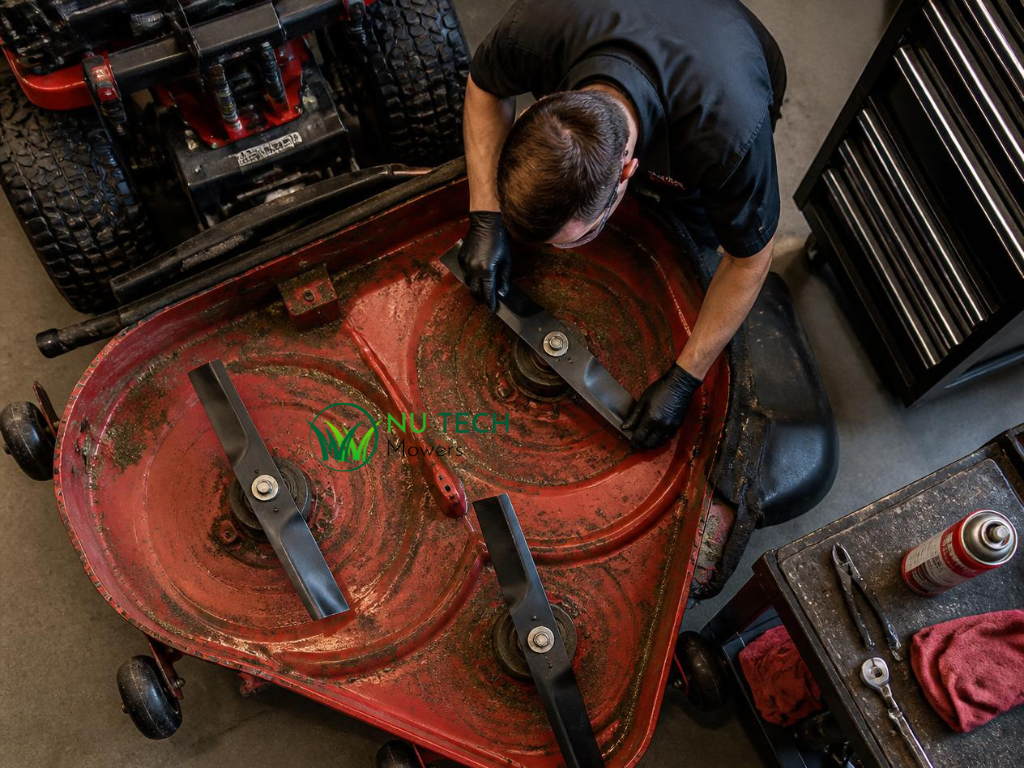
Planning maintenance expenses is part of responsible ride on mower ownership.
The total cost depends on the mower’s type, age, operating hours, condition and the components requiring attention.
Understanding the difference between routine servicing and unexpected repairs can help Australian property owners plan for ongoing equipment care.
Ride On Mower Servicing Costs and Maintenance Planning
Routine servicing may involve inspections, fluid changes, replacement filters, blade maintenance and other tasks specified in the operator manual.
The scope of work depends on the mower.
A petrol machine may require engine-related servicing that is not applicable to a battery-powered model.
A mower with more complex cutting or drive systems may also require different checks.
Replacement parts can influence the total service cost.
For example, worn blades, damaged belts or tyres requiring replacement may add to the expense.
Labour requirements can also vary.
A straightforward scheduled service is different from diagnosing an intermittent electrical fault or repairing a transmission.
For this reason, fixed servicing prices should not be assumed without considering the actual equipment and work required.
Owners should ask what is included in a quoted service.
It is also useful to confirm whether replacement parts and additional repairs require separate approval.
Maintaining records of servicing, operating hours and reported faults can help technicians understand the machine’s history.
Before buying a new mower, customers should also consider parts availability and access to suitable servicing.
A mower that meets the property’s cutting requirements should also be practical to maintain throughout its ownership.
When to Seek Professional Ride On Mower Servicing
Professional servicing becomes important when maintenance involves specialised tools, complicated mechanical components or safety-critical repairs.
Examples include persistent engine problems, damaged drive systems, significant vibration and faults involving braking or steering.
Owners should also seek assistance when they are uncertain about the correct procedure or cannot perform the work safely.
Husqvarna’s maintenance guidance identifies more advanced servicing at particular operating-hour milestones for relevant ride-on models.
However, the actual service schedule must be confirmed against the machine’s operator manual.
When approaching a mower service provider, customers should explain the model, approximate operating hours and symptoms they have observed.
This information can help the technician understand the equipment and determine what inspection may be required.
For homeowners and property owners in Western Sydney, Nu Tech Mowers offers lawn and garden equipment, ride-on mowers and related servicing support.
Its published information covers mower maintenance, product selection and the importance of suitable replacement parts.
Customers can explore the company’s ride-on mower buying guidance and lawn mower maintenance information when reviewing equipment requirements.
Nu Tech Mowers also lists a location in Cartwright, Western Sydney, along with other NSW contact locations.
Before arranging servicing, customers should confirm the particular mower model, available service arrangements and whether the required repairs can be completed at the selected location.
If your mower is due for maintenance, showing unusual symptoms or requires replacement components, you can contact Nu Tech Mowers to discuss the equipment and enquire about suitable servicing options.
Regular maintenance is an important part of owning a ride-on mower, but it does not need to become unnecessarily complicated.
By following the correct servicing schedule, inspecting key components and recognising when professional assistance is needed, Australian homeowners can make informed decisions about maintaining their equipment.
A well-maintained mower is better positioned to deliver reliable lawn mower care, while an organised maintenance approach can help owners manage operating costs and respond to problems before they become more disruptive.
