

Excavators can assist with drainage, trenching, landscaping, soil removal, site preparation and many other construction tasks. However, choosing the largest available machine does not automatically make a project faster or easier.
A compact excavator may pass through narrow residential access and work effectively in a confined backyard. A larger excavator can offer more digging capacity, reach and stability, but it needs more operating space and different transport arrangements.
These choices are particularly relevant across the Macarthur region, where continuing residential development and infrastructure demand are creating a steady mix of home improvement, landscaping and construction work. Camden Council describes the area as one of Australia’s fastest-growing local government areas, with substantial residential, commercial and industrial development expected through to 2046.
When comparing excavator hire Macarthur options, begin with the job and site rather than a preferred machine model. The following guide explains how to compare compact and larger excavators, calculate the full hire requirement and choose a suitable local provider.
What a compact excavator can handle
Compact excavators are commonly considered for residential landscaping, shallow trenching, drainage, garden preparation and work within restricted areas.
Their smaller dimensions can make them easier to manoeuvre between fences, beside homes and around completed surfaces. Some compact machines have retractable tracks that reduce their travelling width, although the machine still requires enough room to turn, operate the boom and position excavated material safely.
Macarthur Hire currently lists a Takeuchi TB210R with an operating weight of 1,150 kilograms and a stated variable width of 750 or 1,020 millimetres. Its product page also lists digging buckets, a mud bucket and a ripper, with a trailer included. Current availability, towing requirements and the exact supplied attachments should be confirmed before booking.
A compact machine may suit a narrow site, but size alone does not establish whether it can complete the job. Digging depth, soil type, required reach and the amount of material being moved also matter.
For example, a small excavator may be able to dig a drainage trench through accessible soil but take considerably longer to remove a large volume of compacted clay or rock. Customers should therefore compare the complete workload rather than selecting a machine only because it fits through the gate.
When a larger machine provides useful capacity
A larger excavator may be more suitable for deeper excavations, bulk soil removal, heavier materials or open construction sites.
Greater machine weight can provide more stability and digging force for suitable work. A longer boom and larger bucket can also reduce the number of movements needed to complete a substantial excavation.
Macarthur Hire’s current website lists a Kubota U55-4 as a four-tonne excavator measuring approximately 5,500 millimetres long, 2,550 millimetres high and 1,960 millimetres wide. The listed equipment includes a set of buckets, a ripper, a dozer blade and a hydraulic quick hitch. The product page states that transport is by tilt tray or float, but project suitability and current transport arrangements require confirmation.
A larger machine can provide useful capacity, but it may be unsuitable for a narrow driveway, soft lawn or tightly developed residential property. It also needs sufficient room to slew without contacting buildings, fences, workers or stored materials.
The decision should therefore balance machine capability with the available operating environment. More digging power only provides value when the excavator can enter, work and leave the site safely.
Measure the Site Before Selecting a Machine
Measure every part of the access route before arranging equipment hire Macarthur services.
Start with the narrowest gate, side passage or driveway opening. Then check whether air-conditioning units, water heaters, garden beds, retaining walls, eaves or fence posts reduce the usable width.
Height is equally important. A machine may fit between the boundaries but be unable to pass beneath a garage door, carport, balcony, tree branch or overhead service.
The measurement should continue beyond the entrance. An excavator needs enough room to position its tracks, rotate its upper structure, extend the boom and place excavated material.
The delivery vehicle also needs suitable access. A tilt tray, float or towing vehicle may require a wider and more stable unloading area than the excavator itself.
Photographs, measurements and a basic site sketch can help a hire provider understand the property. Include the proposed unloading point, travel route, work area and any surfaces that must be protected.
Consider ground conditions, slopes and nearby structures
Ground conditions affect machine stability, traction and the risk of damage to the property.
Wet, soft or recently filled ground may not support the same machine as a firm construction pad. Tracks can also mark lawns, paving and finished driveways, particularly when the excavator turns sharply.
Sloping ground requires careful assessment. SafeWork NSW identifies inadequate ground assessment, overloaded plant and operating near trench edges among factors associated with earthmoving plant rollovers.
Nearby structures must also be considered. Excavation can affect fences, retaining walls, footings and neighbouring property when the work is too close or the ground is unstable.
Underground and overhead services need to be identified before excavation begins. SafeWork NSW requires current essential-services information to be obtained and made available before relevant excavation work starts. It directs NSW workplaces to Before You Dig Australia for underground asset information.
A hire provider can help with machine selection, but it cannot confirm the location of underground services or replace site-specific engineering and safety advice.
Match Digging Capacity to the Project
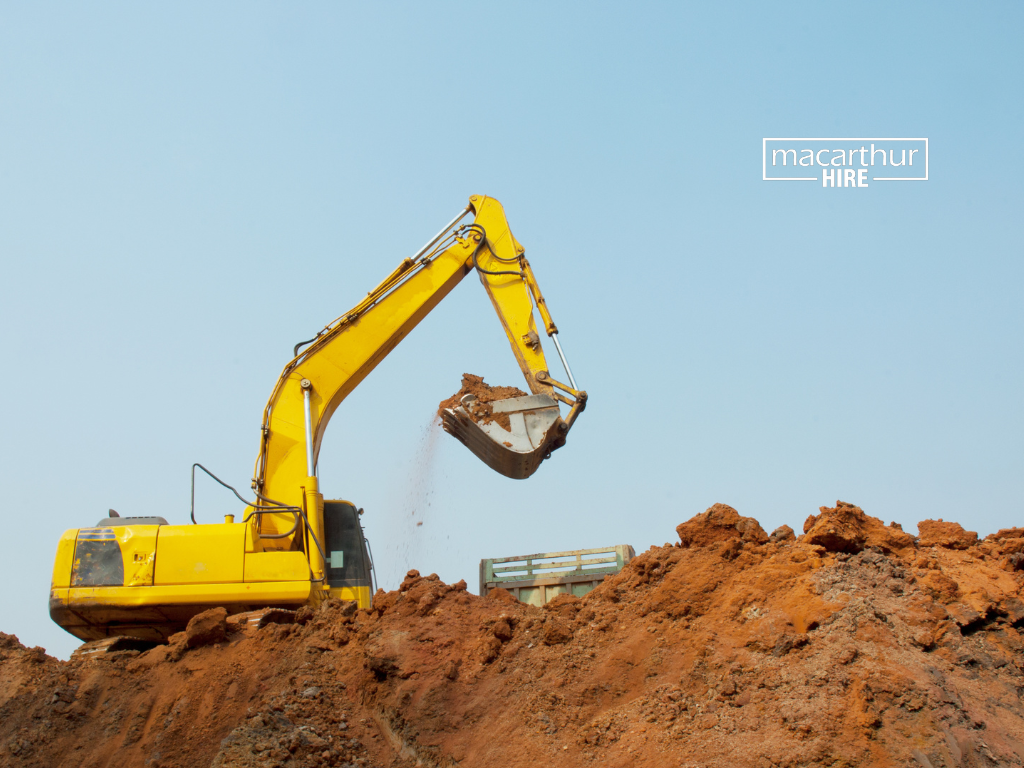
Compare trenching, landscaping and site preparation
Different jobs place different demands on an excavator.
A narrow irrigation trench may require a small bucket and careful operation around existing landscaping. Drainage or service trenches may involve greater depth, spoil management and underground-service controls.
Preparing a garden bed or removing loose soil can suit a compact machine where access is limited. Larger retaining-wall, driveway or construction work may involve greater excavation volumes and heavier materials.
Site clearing may also require more than digging. The excavator may need to remove roots, break compacted ground, load a truck or grade the area after excavation.
Describe the complete project when requesting equipment for hire in Macarthur. A provider needs to understand whether the machine will dig, lift, load, scrape, level or perform several tasks.
A machine selected for only the first stage may become inefficient later. For example, the excavator may dig the required area but lack the reach needed to load the available truck safely.
Consider depth, reach, material and lifting requirements
Digging depth is only one specification. The customer should also consider horizontal reach, dumping height, bucket capacity and working radius.
Soil type can significantly change the workload. Loose topsoil, compacted clay, sandstone and mixed demolition material require different effort and may require different attachments.
Where lifting is involved, the machine’s rated capacity must be considered for the exact working position and attachment. Excavator lifting ability generally changes according to boom position, working radius and site conditions.
SafeWork NSW states that plant used to lift or suspend a load must be designed for that purpose, operate within safe working limits and use suitable attachments. Loads must not travel or remain suspended over people.
Do not rely on the excavator’s overall weight as an indication of what it can lift. The hire provider and machine documentation should be consulted before any lifting task.
For uncertain ground or complex excavation, professional operators or contractors may be more appropriate than self-hire. Operator experience can affect both productivity and the ability to recognise unsafe conditions.
Choose the Right Attachments and Supporting Equipment
The supplied attachment can be as important as the excavator itself.
A narrower digging bucket can suit trenches, while a wider mud or clean-up bucket may be more useful for levelling, loading loose material and finishing the site.
A ripper can help loosen hard or compacted ground before the material is removed. However, it should not be assumed that every form of rock or concrete can be handled with the listed attachment.
Ask which buckets are included and whether their widths suit the project. Additional attachment charges, availability and compatibility should be confirmed before the hire begins.
Customers should also ask how attachments are changed. A hydraulic quick hitch may simplify the process on a suitable machine, but correct connection and checking procedures remain essential.
Where sandstone blocks or other heavy items need to be moved, specialised lifting equipment may be required. Macarthur Hire currently lists a sandstone block lifter and states that compatible excavators may also be available. The attachment’s suitability, working load, machine compatibility and lifting plan must be confirmed for the actual project..
Plan soil movement, compaction and site clean-up
Excavation creates material that must be managed.
Before hiring the machine, decide whether the soil will remain onsite, be spread elsewhere, loaded into a truck or removed in a skip. The excavator needs a safe and practical place to deposit each bucket.
A mini dumper can help move material through access routes that cannot accommodate a truck. A loader may be more efficient when larger amounts of loose material need to be shifted across an open site.
After excavation, a plate compactor may be required to prepare a base or compact backfilled trenches. The correct compaction process depends on the material, layer depth and finished use.
Macarthur Hire’s current earthmoving range includes excavators, a mini dumper, a loader and a plate compactor. Current availability and the suitability of combining these items for one project should be confirmed directly.
Planning these supporting stages before the excavator arrives can reduce idle hire time. It also prevents a situation where digging is complete but the material cannot be moved or the area cannot be finished.
Compare Hire Costs, Transport and Timing
Calculate the complete hire cost
The displayed excavator rate is not necessarily the completed project cost.
The final amount can depend on the hire period, machine, attachments, transport, fuel, cleaning, excess usage, security deposit and damage arrangements.
Delivery can be a significant consideration for larger excavators because a suitable tilt tray or float may be required. A compact machine supplied with a trailer may still require a correctly rated vehicle, towbar, braking connection and competent driver.
Macarthur Hire’s product pages currently display daily, weekend and weekly prices, while noting that prices can change and that delivery and other fees are not included in the displayed estimate. The current total should therefore be confirmed for the requested dates.
Ask whether fuel is included or whether the machine must be returned full. Cleaning expectations and late-return charges should also be clarified.
When comparing equipment rental Macarthur providers, send each one the same project details. This creates a fairer comparison between quotations that may include different machines, attachments or transport arrangements.
Choose a realistic daily, weekend or weekly period
Estimate the hire period from the complete project sequence rather than the expected digging time alone.
Allow time for delivery, unloading, site checks, attachment changes, refuelling, cleaning and collection. Weather, material deliveries and other trades can also affect the schedule.
A daily hire may suit a prepared site and a short task. Weekend hire can provide additional time for a residential project, while weekly hire may offer better value for longer work.
The lowest daily rate does not always produce the lowest completed cost. A machine that is too small may require additional days, while an unnecessarily large machine can increase transport costs and create access problems.
Confirm when the charging period begins and when the machine must be ready for return. Where an extension may be needed, contact the provider before the agreed return time rather than assuming the equipment remains available.
A realistic booking reduces rushed operation, but additional time should not be used as a substitute for proper planning.
Select the Right Equipment Hire Provider
Compare machinery condition, support and hire terms
A suitable provider should ask about the work before recommending an excavator.
The discussion should cover the excavation dimensions, material, access, slopes, operator experience, attachments and expected hire period.
Ask how the equipment is maintained and what pre-hire checks are completed. During handover, the customer should be shown the controls, starting and shutdown procedure, warning indicators and emergency information relevant to the machine.
SafeWork NSW requires earthmoving plant to be adequately maintained and operated by a competent person who receives suitable information, training, instruction and supervision. Appropriate controls must also separate machinery from workers and other people.
The hire agreement should explain authorised use, damage responsibilities, breakdown reporting, fuel, cleaning, transport, cancellation and late returns.
Confirm the machine and service included in the quote
A quotation should identify the excavator model, attachments, hire period and transport arrangements.
Check whether buckets, a ripper, a trailer or other accessories are included. Confirm whether delivery, collection and GST appear in the quoted total.
Macarthur Hire currently advertises a broader range of construction equipment rental categories, including earthmoving equipment, landscaping tools, site services, scissor lifts and trailers. Its actual fleet and availability for a particular Macarthur project should be confirmed at the time of booking.
Customers should also confirm whether the recommended machine can enter the measured site. Product photographs should not be used to estimate width, weight or transport requirements.
Where several machines are being compared, request an explanation of why one is recommended. A useful answer should refer to site access, material, excavation size and the later stages of the project.
Local availability can be convenient, but the decision should still consider machine suitability, clear hire conditions and responsive support.
Know When to Contact Macarthur Hire

Ask for help when site or machine requirements are unclear
Contacting Macarthur Hire may be useful when a customer is choosing between a compact excavator and a larger machine or needs several items for the same project.
Early discussion is particularly valuable where access is narrow, the excavation is deep, the ground is difficult or the machine needs a specialised attachment.
The provider may also help explain whether delivery, trailer transport or another arrangement is more appropriate. The final decision must still comply with vehicle, towing and site requirements..
Customers should not wait until the morning of the job to identify access or transport problems. Measurements and photographs can be reviewed before the equipment is allocated.
The provider can recommend hire equipment, but excavation safety, underground-service location, structural issues and regulated work may require separate professional advice.
Prepare useful details before requesting a booking
Begin with the job address and a clear explanation of what needs to be completed.
Provide the approximate length, width and depth of the excavation. Describe whether the material is loose soil, compacted clay, sandstone, roots, mixed fill or another material.
Measure the narrowest access point and note overhead restrictions, slopes, soft ground, retaining walls and nearby buildings.
Explain where the excavated soil will go and whether a dumper, loader, compactor, truck or trailer may also be required.
State the preferred dates, expected hire period and whether delivery is needed. Describe the operator’s previous experience and ask what competency or site requirements apply.
Finally, request confirmation of the model, attachments, transport, total price, bond, fuel policy, cleaning requirements and return arrangements.
Choosing excavator hire Macarthur services becomes easier when the decision is based on the actual site and workload. A compact excavator can provide useful access for smaller jobs, while a larger machine may offer the capacity needed for substantial excavation. The right option is the one that can enter the site, complete the required work and operate within a properly planned environment.
